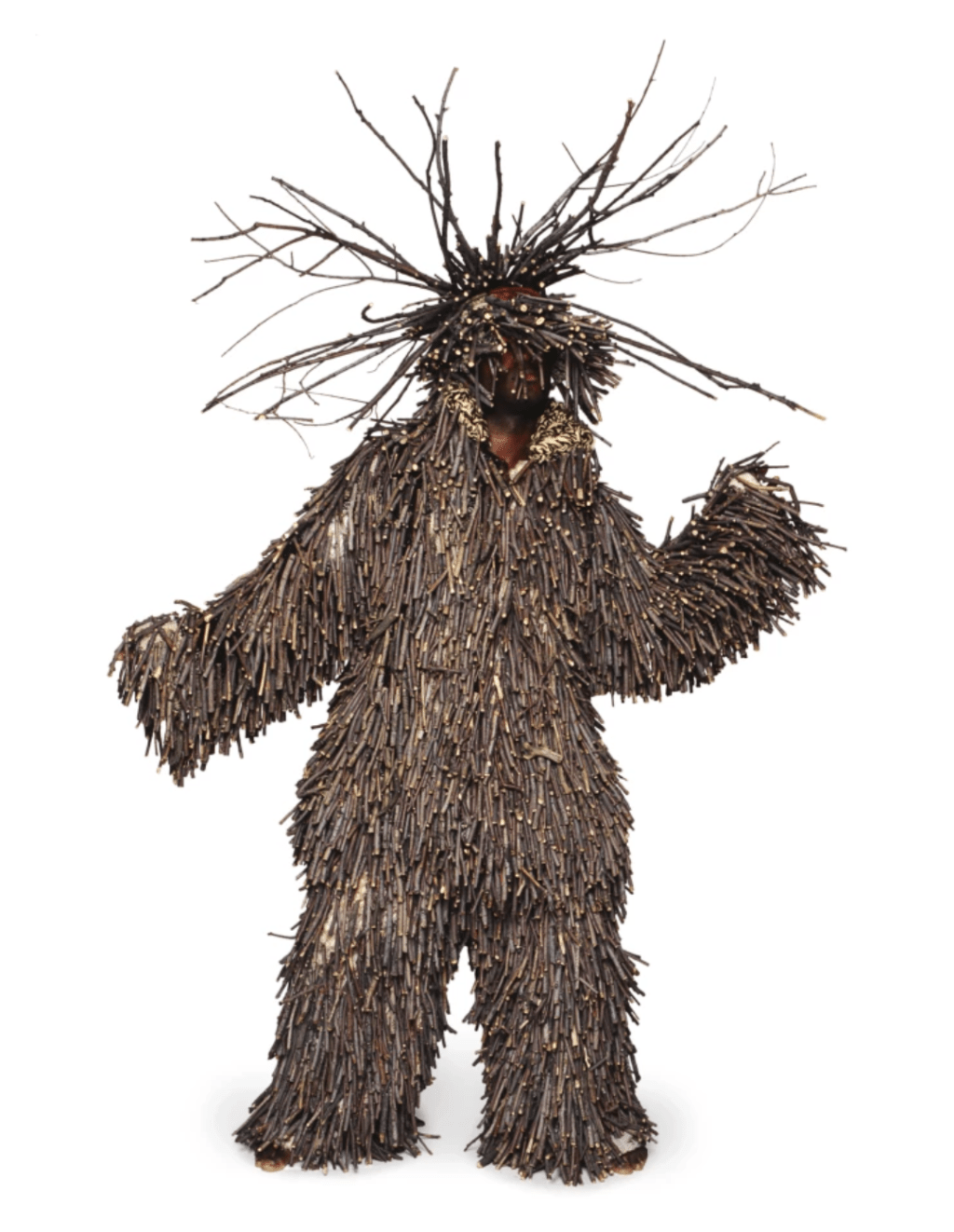
Although Soundsuit (1992), the first in a series of movable, wearable, and often audible art/performances pieces, is both barrier and blind, from the outside looking in it is difficult to equate a garment made from nature’s broken and brittle remains with armor. Uninhabited, the sight of Soundsuit always floods me with impressions of danger and suffering that keeps the need for safety top of mind. The crowned Christ suffering upon the Cross. Lonely, desperate spaces of darkness and despair. Rattles of extinction competing with the rhythms of life. Hidden woods and hungry fires. A spark, equal parts rage and genius, setting an artist on fire creatively, emotionally, and spiritually.
Powerful imagery which does much to explain why the respite of anonymity is desirable to people of color.
The dry sticks, as dry as the bones of depression, bitterness, hopelessness and the like, discussed by Ezekiel in 37: 1-28, cannot protect the body against the outrages of man’s inhumanity to man. The physical, however important, is not all. The protection of our emotional and spiritual parts are of equal if not more importance, and it is these fundamentally human characteristics which are best protected by and exalted through Soundsuit.
Merriam-Webster – Armor as physical protection
- Defensive covering. Especially: (as of metal) used in combat.
- A quality or circumstance that affords protection.
- A protective outer layer that (as of a ship, a plant, or animal, or a cable\
- Armored forces or vehicles
Those who study the mind have differing interpretations about the cause and role of emotional armoring. Is this protection consciously or unconsciously formed and when? Can it be practiced and with practice strengthened? Is armoring positive or negative? Is is a filter through which we process experience and gain equilibrium, or a battle-hardened shield forged by trauma against further insult? The following theories are from two contemporary professionals, and one from the early 1900’s.
Dr, George S. Everly, Jr., an award-winning author, researcher, and creator of Psychological Body Armor created evidence-based strategies to retain and reestablish stability in times of adversity and enhance overall immunity from the stressors of career and life. Dr. Everly’s version of emotional armoring is positive, a means to build a personal culture of resilience. In the article, It’s Time to Speak Unapologetically to Black America’s Emotional Wounds, Dr, Wizdom A. Powell, discusses emotional armoring by black people. She explains the process as defensive and a means to remain functional in a state of racialized trauma and battle fatigue. Dr. Powell asserts that mainstream failure to name and claim America’s sordid past of weaponizing black mental health issues existed during enslavement and continues today. In this instance, emotional armoring may be described as protection against race-based bombardment.
Lastly, I refer to the somewhat controversial work of Wilhelm Reich, an Austrian doctor of medicine, psychoanalyst, and student of Sigmund Freud, who in the early 1900’s advanced the theory of character armor. According to Dr. Reich, character armor is comprised of coping patterns which evolve throughout life, probably starting before coherent thinking and verbal communication skills develop. These emotional protections adapt in response to the behavior of surrounding people places and things. In this reference, emotional armoring seems a natural component of development.
At the time of the 1992 Los Angeles riots, Mr. Cave was 33, about the same age as Mr. King. He was black like Mr. King. Unlike Mr. King, he was also gay, another factor which made him an even more likely target of violence in general, and police violence in particular. Nick Cave’s origins appear to be much less volatile. He was born in Jefferson City, Missouri, in 1959. He began exploring fiber arts and fashion while attending the Kansas City Art Institute where he completed an B.F.A. In 2982. During that time Mr. Cave also studied with the Alvin Ailey modern dance company. It could have been this diversity of experience that engendered an interest in developing a practice which blended dance, fashion, and art. Mr. Cave continued his arts education in Michigan at the Cranbrook Academy of Art in Bloomfield Hills where he completed a Master’s degree in fine arts, and went on to become the chair of the fashion design program at the School of the Art Institute of Chicago.
Significant media exists in which Nick Cave shares insight about his diverse body of work and the dynamic reach of his practice. He is, however, most associated with the Soundsuits he has been constructing and activating since the brutal assault of Rodney King on March 3, 1991. The need for protective armor as well as a desire for anonymity and a safe space was amplified for black people, black men in particular, around this and subsequent events.
Rodney Glen King, and African American man, after evading arrest was apprehended by four officers. Then, the unarmed, kneeling suspect was battered with a billy club, stunned, which disrupted his nervous system and burned his chest, and had his leg broken after which the officers drew their guns and aimed them at. Mr. King. He thought he was about to die. However, unbeknownst to the officers, their actions and those of Mr. King were filmed by George Holliday, a bystander, from a nearby balcony. KTLA, the local news station to which Mr. Holliday sent the footage, aired it and the story was quickly picked up by new media world wide.
The four officers involved were reportedly disciplined for excessive force and three of them were criminally charged. Those charged were acquitted, and this judicial failure resulted in the 1992 Los Angeles riots. Despite Mr. King’s pleas for peace, civil unrest raged for six day until it was , ultimately ended by the combined efforts of police, California Army National Guard, The Unites States Army, and the United States Marine Corps. 63 people died and 2383 were injured.
The indisputable demonstration of racialized brutality inflicted upon Rodney King played out on television screens across America. The officers’ unrepentant abuse of authority, obvious lack absence of moral decency, and refusal to acknowledge the shared humanity between law enforcement officers and a person in their custody made no difference in the end and the seething anger of the marginalized, mistreated, and ignored erupted. It was in this fiery furnace of danger, inequality, trauma, and injustice that Nick Cave created the first Soundsuit
Recently, I had the opportunity to see many of Mr. Cave’s Soundsuits at the Museum of Contemporary Art in Chicago. And although they are all remarkably and beautifully diverse, I am most drawn to the original. Some of my fascination is attributable to the fact that it was the first, and because it was crafted and activated in protest of an event that is burned into my memory. There is no question that Soundsuit offers a unique visual and auditory experience. However, the generative impulse that inspired Mr. Cave to gather fallen twigs and branches from the Chicago’s Grant Park and Mr. Cave’s initial sorrow and disappointment and, later, the joy of his surprise and discovery, his process, is as compelling to me as his creation. Within Soundsuit he found away to protect the most vunerable, ephemeral parts of himself and establish a cultural connection point for those who share African heritage. And one man’s, one artist’s, objection to and protection against the brutalities of the 1990’s is no less timely or relevant as a protest piece against the same outrages that persist in the 2020’s.
The Bible (Ephesians 6:10-17)
The Full Armor of God–Armor as spiritual protection
The Belt of truth
The Breastplate of Righteousness
The Shoes if the Gospel of Peace
The Shield if Faith
The Helmet of Salvation
The Sword of the Spirit which is the Word of God
Ideas for Imagery
Grayscale: first Soundsuit, Rodney King, Nick Cave
Sources
Encyclopedia Britannica: Nick Cave
Johns Hopkins Center of Humanitarian Heath: George S. Everly, Jr. PhD, ABPP, FACLP
George S. Everly, Jr., PhD., Psychological Body Armor.
Wizdom A. Powell, Ph.D.
Los Angeles Times: Rodney Glen King
Wikipedia: Rodney Glen King
Youtube: Great Big Story: How Police Brutality Inspired These Works of Art 2019
NAME AND IMAGE
Just include my initials and a black oval for a personal image
 T. Jordan Christmas II Puppetry Performance & Design
Leave a comment